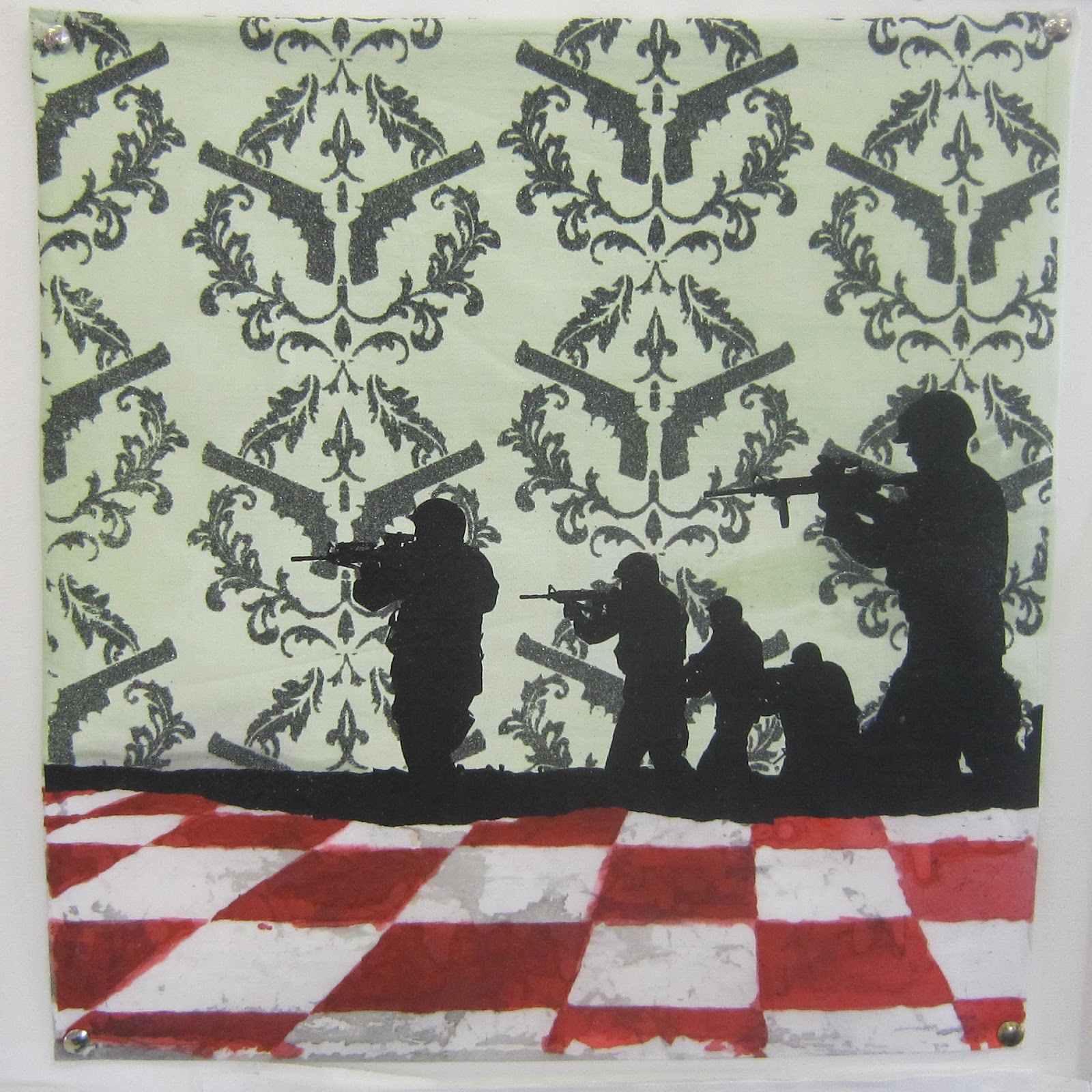
Most of the following work is not easily placed within one specific technique because of the level of experimentation and mixing of techniques. For the purpose of this review I have attempted to loosely categorise the work based on either the predominant technique used or because that one particular aspect or technique interests or inspires me.
Stitching, Embroidery, Appliqué and Bond Web
The choice of materials and the use of thick, compact machine stitched lines give this street composition an eccentric and fun element which is reinforced by the overlapping of seemingly random composition. All the elements work together to create a really interesting to create a fantasy childlike street scene.
The intricate use of clashing materials and the choice of colour in the stitching and the chunky, almost clunky "drawn" lines are reminiscent of a children's book illustration.
In contrast I find the next two pieces use the lines of the sewing machine to define and create clean lines.
Great care was taken when screen printing this piece and there was a lot of careful time given to stitching this piece. What I find interesting is the contrast in the results of the white and red lines. Changing the thickness of the line and thread and attempting to create curves using the sewing machine can be very difficult. However the creation of a striking image which incorporates space and precision is very interesting.
This hand painted piece has also incorporated machine stitching but it is more organic and less contrasting. I love the subtle detail in both the painting and the colour fades and washes and the stitching which appears like cracks or scars on the surface.
Traditionally I always conceived appliqué as adding small materials to a piece. The use of fabric painting which looks like screen printing and the incorporation of an entire scarf adds a sculptural quality. I also like the way part of the scarf is hand knitted, adding another technique and medium.
The intricate work and detail of the next two pieces can only be fully appreciated in my opinion by also looking at the preparation work. The final works grew from a series of visual, textural and particularly for the below piece, symbolic investigation.
The mix of hand and machine stitching gives this work more of an organic feel especially when taking into consideration the subject matter or trees. I also like the use of unexpected colours which are moving away from traditionally outdoor landscape colour palettes. The reds and purples remind me of David Hockney's recent landscapes.
Amazing use of detailed appliqué considering the time taken to hand stitch these beautiful constellations.
Really interesting use of wax. I like the idea of incorporating non traditional fabric materials.
I love the folkish, traditional feel from this piece. The attention to detail especially with the flowers and vegetable patch are just charming. The use of bright colours, especially the contrast blue sky and pink/purple house are visually exciting,and I also think the various fabrics were used very well to emulate the various elements.
The exploration and experimentation using mixed media in this piece is very interesting. The material is batiked but I think its the variety of materials, found objects, natural and man-made, which is what I find most interesting. This piece appears almost organic in nature.
The ghostly black and white image of the image transfer works really well with the textural and definitive lines created by the machine and hand sewn lines. I think the fact that they also contrast not just materially but because they are coloured works as the lines are part of the fabric but also physically come outside of both the fabric itself but also extend beyond the boundaries of the actual image.
The scale and delicate intricate detailed hand sewn work is very striking about this piece.What I like most though is the physical construction of the "plane wing". The unusual frame created to stretch the canvas is what differentiates it from a simple needle point or hand stitched piece.
The piece exemplifies what can be achieved when dyeing fabric using the same dye but experimenting with times. The piece reminds me of the inside of a cave or a cliff face which has been worn away slowly and over time. The delicate and natural shades for me refer to the natural world. Also I really like the way the edges and the surfaces are not interrupted by stitching. The bond web attaches these pieces of fabric with minimal interference to the fabric surface.
The natural crack lines achieved from scrunching fabric when dying add to the aged feel.
Batik and Fabric Painting
Careful planning for all textile work is essential but I feel it is absolutely necessary when creating a batik. I have included some prep work to exemplify how the design work influences the final work, but also to show that there is still an organic nature when using these techniques. The final works do not always correlate exactly and this is sometimes where the most interesting effects are achieved.
The part of this piece which I like and initially did not even consider is the roots of the tree. They stand out white against the muddy colours and even though the figure and the tree dominate the piece, it is this subtle spider web pattern which I find intriguing. Physically painting on fabric on dye accurately can be very difficult and the colours and tones can vary. I like the smudgy and transparent qualities if the sky where the dye has cracked and seeped and uniformity is impossible.
Personally I love black and white and often restrict myself to black, white and grey ion my own practice. I find there can be a great subtly of detail achievable and this is apparent in these works. The cracks from the dyeing technique work as the lines in the tree bark that this was inspired by. Good mastering of timing of the fabric dye is obvious here.
This piece is a great example of how the wax can be etched into in order to create a pattern or to draw on to design. The entire piece was totally waxed and then the patterned border was etched allowing the dye to seep through into the cracks.
The incorporation of wax and the difficulty in controlling the spread of the dye when fabric painting often prevents great or very precise detail. Careful handling of the wax and the dye (and the use of a hair dryer) shows that detail should not be restricted when fabric painting.
Screen Printing
I like the practical application of actually creating a usable object, in this case a cushion. This inspires me to think what else the fabrics/textiles created could be used and incorporated into; perhaps, clothing such as t-shirts and bags or costumes or more experimental fashion design pieces, or soft furnishings, such as wall hangings or lampshades.
This piece was inspired by a sculpture. I think creating a piece based on or inspired by another artwork, in particular that created in another medium such as a painting or sculpture. Re imagining something in another medium intrigues me and textiles, because of the huge variety of techniques, materials and ultimately possibilities, is a great area in which to explore visual and textural/sculptural qualities.
The use of creating a screen print looking image using glue instead of paint and then adding sprinkling another medium on is a novel idea.
Photograph and Printed Image Transfer
The possibilities of subject matter is endless with this technique. I really like the ability to really personalise the work and use personal or found imagery so explicitly.
I like the faded look of this work and the use of advertising slogans and symbolism.